
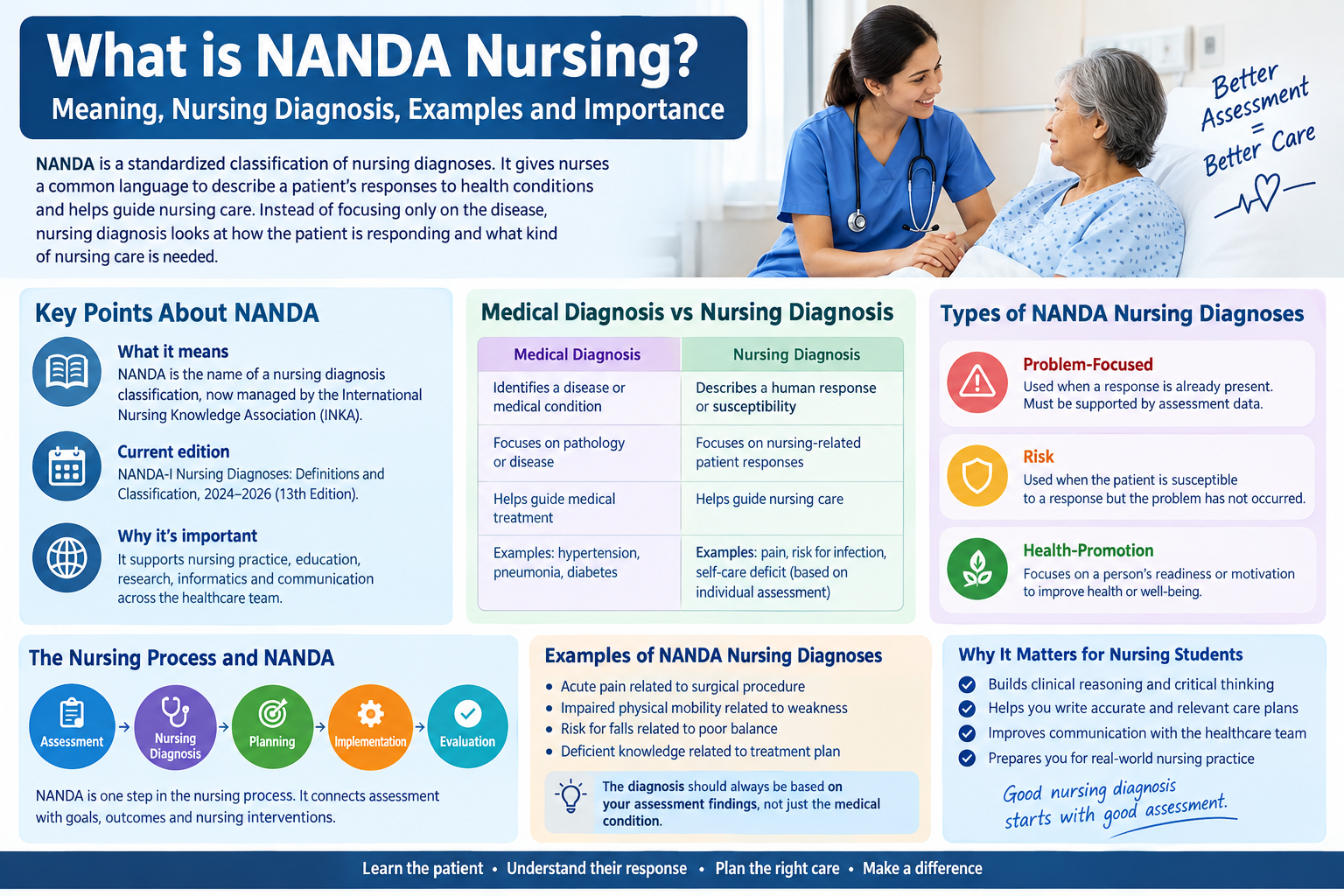
NANDA Nursing Meaning, Nursing Diagnosis, Examples, and Importance
If you are studying GNM or BSc Nursing, you have probably come across the word NANDA while preparing a nursing care plan. Many students initially think that NANDA is simply a list of nursing diagnoses that they need to memorize for exams. In reality, it is much more useful than that.
NANDA is associated with a standardized classification of nursing diagnoses. It gives nurses a common professional language for describing a patient’s responses to health conditions and life situations. Instead of looking only at the disease a patient has, nursing diagnosis asks another important question: How is this patient responding to the health problem, and what nursing care does the patient need?
For example, imagine two patients who have the same medical condition. One may be experiencing severe pain, another may have difficulty moving, and a third may be worried because they do not understand their treatment. Their medical diagnosis may be similar, but their nursing needs can be quite different. This is where nursing diagnosis becomes useful.
If you are learning NANDA nursing diagnosis for the first time, don’t worry about memorizing everything at once. Once you understand the difference between a medical diagnosis and a nursing diagnosis, the rest of the topic becomes much easier.
What Does NANDA Mean in Nursing?
The name NANDA has a long history in nursing. It was originally associated with the North American Nursing Diagnosis Association, but that is no longer the organization’s current name. The organization explains that the word NANDA has been retained because it is widely recognized within the nursing profession and is now best understood as an established name associated with its nursing diagnosis classification. In 2026, the organization transitioned to the International Nursing Knowledge Association (INKA).
This change can be confusing if you are reading older nursing books or websites. You may still see NANDA-I, NANDA International, or simply NANDA in study materials. The important thing for a nursing student is to understand what the nursing diagnosis classification is used for.
The current classification is NANDA-I Nursing Diagnoses: Definitions and Classification, 2024–2026, 13th Edition. The official NANDA/INKA website identifies this as the current edition and states that it was published in April 2024.
In simple words, you can think of NANDA as a standardized nursing language that helps nurses describe patient responses in a consistent and clinically meaningful way.
What Is a Nursing Diagnosis?
A nursing diagnosis is a clinical judgment made by a nurse about a patient’s response to a health condition or life process.
This definition becomes much easier when you look at a real situation.
Suppose a patient has undergone surgery. The medical team may document the medical condition and surgical procedure. The nurse, however, needs to look at the patient from a nursing perspective.
Is the patient experiencing pain?
Can the patient move comfortably?
Is the patient able to perform normal activities?
Is there a risk of falling?
Does the patient understand the treatment?
Is the patient anxious about the procedure?
Does the patient need help with personal care?
These questions lead the nurse toward the patient’s nursing needs and responses.
So, nursing diagnosis is not simply another name for the medical disease. It is based on nursing assessment and clinical judgment.
Nursing Diagnosis vs Medical Diagnosis
This is one of the most important concepts for nursing students.
A medical diagnosis identifies a disease, disorder, or medical condition. A nursing diagnosis focuses on the patient’s response or susceptibility to a response that is relevant to nursing care.
For example, hypertension is a medical diagnosis. A nurse caring for a patient with hypertension does not automatically write “hypertension” as the nursing diagnosis. Instead, the nurse assesses the individual patient and determines what nursing concerns are actually present.
The patient may have difficulty managing the treatment plan, insufficient knowledge about lifestyle changes, anxiety, or another nursing concern. The correct diagnosis depends on what the nurse finds during assessment.
| Medical Diagnosis | Nursing Diagnosis |
|---|---|
| Describes a disease or medical condition | Describes a human response or susceptibility to a response |
| Focuses mainly on pathology or disease | Focuses on nursing-related patient responses |
| Helps guide medical treatment | Helps guide nursing care |
| Examples include hypertension, pneumonia and diabetes | Examples depend on the patient’s individual assessment |
The two types of diagnosis are not competitors. They work together. A patient can have one medical diagnosis and several nursing diagnoses because patients can have multiple responses and nursing needs at the same time.
Why Is NANDA Important in Nursing?
Nursing involves communication between many people. A patient may be cared for by different nurses during different shifts, and information may also need to be communicated to other members of the healthcare team.
Using standardized nursing terminology gives nurses a common language.
It also helps nursing students develop a more organized way of thinking. Instead of writing a care plan simply because the teacher asked for one, the student learns to begin with assessment, identify important findings, and then decide which nursing concerns are supported by those findings.
The official NANDA/INKA material describes the classification as a resource for nursing practice, education, research, informatics and other areas of nursing knowledge.
There is another important benefit: NANDA encourages assessment-driven thinking. You do not select a diagnosis just because the patient has a particular disease. You select it because the assessment gives you evidence that the diagnosis applies to that individual patient.
How Does NANDA Nursing Diagnosis Work?
The easiest way to understand the process is to start with a patient rather than with a diagnosis.
Imagine a patient who says, “My leg hurts when I try to walk.” You notice that the patient is moving slowly and needs support while getting out of bed.
A student who is memorizing diagnoses might immediately search for a diagnosis related to mobility. A student who is developing clinical reasoning will first ask more questions.
How severe is the pain?
When did it begin?
Can the patient bear weight?
Is there weakness?
Does the patient need assistance?
Is the patient at risk of falling?
What is preventing normal movement?
This assessment provides the information needed to decide whether a particular nursing diagnosis is appropriate.
That is the basic idea behind NANDA nursing diagnosis: assessment comes before diagnosis.
Assessment Comes First
Good nursing diagnosis starts with good assessment.
During assessment, the nurse may collect subjective information from the patient and objective information through observation, physical examination, measurements, records and other appropriate sources.
For example, “I feel dizzy when I stand up” is information reported by the patient. Blood pressure readings, gait observations and other measurable findings may provide additional objective information.
The nurse then looks at the complete picture rather than focusing on one isolated sentence.
This is especially important for students. If the assessment is weak, the diagnosis may also be weak. A care plan can look perfectly formatted on paper and still be clinically inappropriate if it is not supported by patient data.
Types of NANDA Nursing Diagnoses
Students commonly learn several broad types of nursing diagnoses. The current classification should always be consulted for the exact definitions and diagnostic requirements because terminology can change between editions.
Problem-Focused Nursing Diagnosis
A problem-focused nursing diagnosis describes a response that is currently present.
There should be assessment evidence supporting the diagnosis. For instance, if a patient is experiencing a particular nursing problem, the nurse should be able to point to findings that demonstrate the problem.
This is why copying a diagnosis from a textbook without checking the patient’s condition is not good nursing practice.
The diagnosis should fit this patient, not just the disease written on the admission sheet.
Risk Nursing Diagnosis
A risk nursing diagnosis is used when a patient is susceptible to developing a particular undesirable response.
The difference is important.
If the problem is already present, it may be appropriate to consider a problem-focused diagnosis. If the patient has factors that place them at risk but the problem has not occurred, a risk diagnosis may be more appropriate.
For example, a weak patient with poor balance and environmental hazards may have factors that increase the risk of falling. Nursing care can then focus on prevention.
Health-Promotion Nursing Diagnosis
Nursing is not only about illness. Nurses also help people improve their health and develop healthier behaviors.
Health-promotion diagnoses relate to a person’s readiness or motivation to improve health-related behaviors or well-being.
This area is particularly relevant in community health nursing, health education and preventive care.
What Are the Components of a NANDA Nursing Diagnosis?
This is where many nursing students become confused.
The current NANDA classification provides standardized information around diagnoses, including the diagnostic label, definition and relevant diagnostic indicators. Depending on the diagnosis, these may include defining characteristics, related factors, risk factors, associated conditions and at-risk populations.
You may also see different care-plan formats used by different nursing colleges. Your instructor may ask you to write a diagnosis using a specific structure.
Rather than memorizing one formula from an old website, use your current nursing textbook and the format recommended by your college.
The most important rule is simple: the diagnosis must be supported by your assessment findings.
Simple Examples of NANDA Nursing Diagnosis
Let’s make this practical.
Suppose a patient has difficulty walking after surgery. During assessment, the patient reports pain while moving and requires assistance to change position. The nurse also observes reduced mobility.
The nurse can analyze these findings and determine whether they support a standardized diagnosis related to the patient’s mobility.
Now consider another patient who has weakness and poor balance. The patient has not fallen, but the assessment identifies factors that make a fall more likely. The nurse may consider an appropriate risk diagnosis if the current classification criteria are met.
Another patient may report significant pain after a procedure. The nurse assesses the location, intensity, duration, characteristics and effect of pain on movement or sleep. If the assessment supports an appropriate diagnosis, nursing interventions can then be planned around that problem.
Notice something important in all three situations: the diagnosis is not chosen simply because of the medical condition.
The patient’s actual assessment findings matter.
How to Write a NANDA Nursing Diagnosis
If you are a GNM or BSc Nursing student, use this simple approach while practicing.
First, collect the patient data. Don’t rush to write the diagnosis.
Second, group related findings together. Look for a pattern rather than treating every symptom as a separate problem.
Third, ask yourself, “What patient response is this information showing?”
Fourth, check the current NANDA classification to see which standardized diagnosis best fits the situation.
Finally, make sure your diagnosis is supported by the information you collected.
For example, don’t select a diagnosis merely because the patient has diabetes, hypertension or pneumonia. Ask what the patient is actually experiencing and what nursing care is required.
This approach may take a little longer when you first learn it, but it becomes much easier with practice.
NANDA Nursing Diagnosis and the Nursing Care Plan
A nursing diagnosis is one part of the larger nursing process.
A simple way to remember the relationship is:
Assessment → Nursing Diagnosis → Planning → Implementation → Evaluation
Assessment tells you what is happening with the patient. Nursing diagnosis identifies an important nursing concern. Planning determines the desired outcomes and appropriate interventions. Implementation is when the planned nursing actions are carried out. Evaluation checks the patient’s response.
The process is continuous.
For example, a patient’s pain may improve after appropriate nursing interventions. Once the patient’s condition changes, the nurse reassesses the situation and determines whether the care plan still needs to continue, change or be discontinued.
The official NANDA/INKA work is also moving toward a broader NANDA 360 approach that connects diagnoses with goals, outcomes and nursing actions.
Why Students Should Not Simply Copy Nursing Care Plans
Searching online for a nursing care plan can be useful when you are trying to understand the format. The problem begins when students copy an entire care plan without checking whether it matches their patient.
A patient is not a textbook case.
For example, two patients admitted with the same disease may have different levels of pain, mobility, anxiety, knowledge, family support and ability to perform self-care. Their nursing diagnoses may therefore be different.
When preparing a college assignment, use examples as learning material, but base the final care plan on the assessment information provided in your case.
This also makes your work more meaningful. Instead of simply filling in boxes, you are demonstrating that you understand why a particular nursing diagnosis applies.
Common Mistakes in NANDA Nursing Diagnosis
One of the most common mistakes is writing the medical diagnosis as the nursing diagnosis. Remember that the nurse needs to identify the patient’s nursing response.
Another mistake is choosing a diagnosis before assessment. If you decide on the diagnosis first and then search for symptoms that seem to fit it, your clinical reasoning can easily become biased.
Using outdated terminology is another problem. Nursing classifications are revised, so students should not assume that every list found online is current.
A further mistake is selecting too many diagnoses. A long care plan is not automatically a good care plan. It is better to identify relevant priorities supported by assessment data than to add diagnoses simply to increase the number of pages.
Finally, avoid treating NANDA as a memorization-only subject. Understanding why a diagnosis fits the patient is much more useful than remembering a label without knowing when to use it.
NANDA Nursing Diagnosis for GNM Students
For GNM students, the easiest way to learn NANDA is through patient situations.
Take a simple case from medical-surgical nursing. Read the patient’s history and assessment findings. Underline the important information. Then ask what the patient is experiencing from a nursing perspective.
For example, if the patient reports pain, has difficulty moving and needs help with activities, don’t immediately write three diagnoses. First understand the situation. Which problem is most important? What evidence supports it? What can nursing do about it?
You can repeat this exercise with different patient cases.
After practicing several cases, you will begin to recognize patterns. This is much more useful than trying to memorize a huge list of nursing diagnoses before you understand their meaning.
NANDA Nursing Diagnosis for BSc Nursing Students
BSc Nursing students may need to go a step deeper into the reasoning behind nursing diagnosis.
At this level, it is useful to understand how assessment data, clinical judgment, standardized terminology, outcomes and nursing interventions are connected.
The current NANDA classification is not simply a dictionary of labels. The official organization describes it as a foundational clinical and scholarly resource that supports standardized nursing language and clinical reasoning.
Students working on assignments, research projects or evidence-based nursing topics should therefore use a current edition and cite the appropriate source rather than relying only on online lists.
What Is the Current NANDA Edition?
The current official classification listed by NANDA/INKA is NANDA-I Nursing Diagnoses: Definitions and Classification, 2024–2026, 13th Edition. It was published in April 2024.
The organization reported that the 13th edition included 54 completely new diagnoses and 98 revised diagnoses, showing why students should be careful when using older study material.
Another current development is the organization’s transition from NANDA International to the International Nursing Knowledge Association (INKA) in 2026. The organization states that NANDA remains the name associated with the nursing diagnosis classification.
For exam preparation, always follow the textbook and classification edition recommended by your nursing institution.
Why Standardized Nursing Language Matters
Imagine that ten nurses describe the same patient problem in ten completely different ways. Even if everyone understands the general idea, communication can become difficult.
Standardized terminology gives nurses a shared professional language.
It can help with communication, education, research, electronic documentation and continuity of care. The official NANDA/INKA resources describe standardized diagnoses as supporting these different areas of nursing knowledge and practice.
But standardized terminology does not replace the nurse’s judgment. A classification can provide the language, but the nurse still has to collect information, interpret it and decide what is relevant to the individual patient.
That human clinical judgment is an important part of nursing.
NANDA Nursing Diagnosis in Real Clinical Practice
In a hospital, a nurse may care for several patients during one shift. Each patient has different problems and priorities.
One patient may need help with mobility. Another may need pain management. Someone else may require education before going home. Another patient may need close monitoring because of a particular risk.
Nursing diagnosis helps organize these concerns.
The nurse assesses each patient, identifies relevant nursing responses, plans care, carries out interventions and evaluates the results. If the patient’s condition changes, the nurse reassesses the situation.
This is why NANDA should not be viewed only as an examination topic.
It is connected to the larger idea of professional nursing judgment.
NANDA vs NANDA-I vs INKA: What Should Students Know?
If you search online today, you may encounter all three terms: NANDA, NANDA-I and INKA.
The simplest way to understand them is this:
NANDA is the familiar name retained for the nursing diagnosis classification.
NANDA-I refers to the former name and commonly used abbreviation associated with NANDA International.
INKA, or the International Nursing Knowledge Association, is the organization’s current name following its 2026 transition.
The official organization specifically explains that the name NANDA has been retained because of its strong recognition in nursing.
So, if your textbook says NANDA-I and a current website mentions INKA, don’t assume they are completely unrelated. Check the publication date and context.
Frequently Asked Questions
1. What is NANDA in nursing?
NANDA is the established name associated with a standardized classification of nursing diagnoses. It provides terminology that helps nurses describe patient responses and support nursing clinical reasoning, documentation, education and research.
2. What does NANDA stand for?
Historically, NANDA was associated with the North American Nursing Diagnosis Association. That is no longer the organization’s current name. In 2026, the organization transitioned to the International Nursing Knowledge Association (INKA), while retaining NANDA as the name of the nursing diagnosis classification.
3. What is NANDA nursing diagnosis?
A NANDA nursing diagnosis is a standardized nursing diagnosis based on nursing assessment and clinical judgment. It focuses on a patient’s human response or susceptibility to a response rather than simply naming the medical disease.
4. What is the latest NANDA edition?
The current classification listed by the official organization is NANDA-I Nursing Diagnoses: Definitions and Classification, 2024–2026, 13th Edition.
5. Is NANDA important for GNM nursing students?
Yes. Learning NANDA nursing diagnosis can help GNM students understand the nursing process, prepare care plans and develop clinical reasoning. The most useful approach is to learn how assessment findings lead to a diagnosis instead of memorizing diagnosis names alone.
Conclusion
If you remember only one thing from this article, remember this: NANDA nursing diagnosis is about understanding the patient, not simply naming the disease.
A medical diagnosis tells us what disease or medical condition the patient has. A nursing diagnosis helps the nurse identify how that patient is responding and what nursing care may be needed.
For GNM and BSc Nursing students, the best way to learn this topic is to connect it with real patient situations. Start with assessment, look at the patient’s responses, identify the nursing problem supported by the evidence, and then use the appropriate standardized terminology.
The current official classification is NANDA-I Nursing Diagnoses: Definitions and Classification, 2024–2026, 13th Edition. The organization behind the classification also transitioned to the International Nursing Knowledge Association (INKA) in 2026, while retaining NANDA as the name of the nursing diagnosis classification.
For a nursing student, NANDA is not just another topic to memorize for an exam. It is a way of learning how to look at a patient through the lens of nursing care.
Good nursing diagnosis begins with good assessment.