
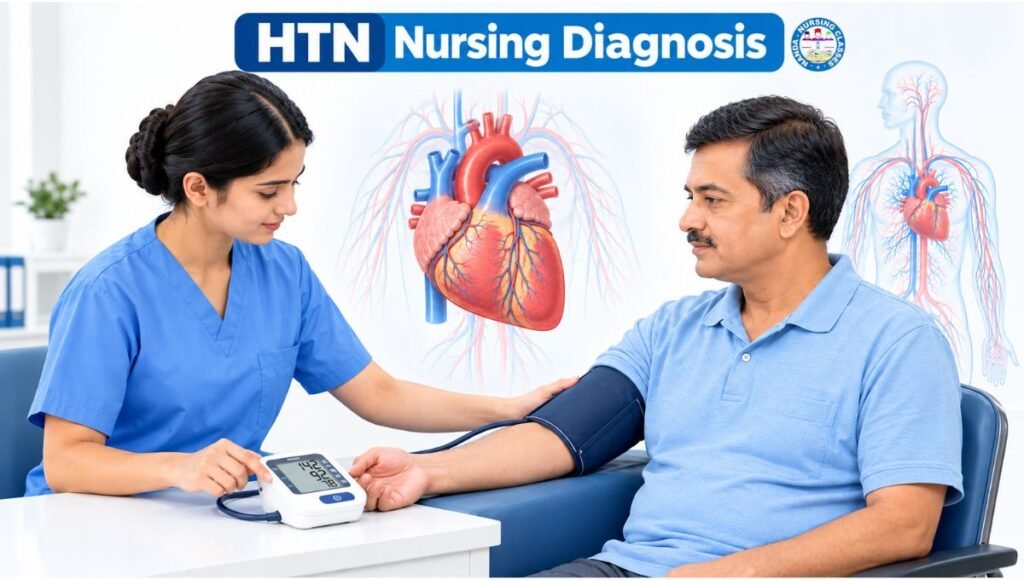
Comprehensive Outline of HTN Nursing Diagnosis
| Section | Topic Covered |
|---|---|
| 1 | Introduction to HTN Nursing Diagnosis |
| 2 | What Is Hypertension? |
| 3 | What Is a Nursing Diagnosis? |
| 4 | Why Nursing Diagnosis Is Important in HTN |
| 5 | HTN Nursing Assessment |
| 6 | Common Assessment Findings |
| 7 | HTN Nursing Diagnosis Examples |
| 8 | Risk for Decreased Cardiac Output |
| 9 | Acute Pain |
| 10 | Anxiety |
| 11 | Deficient Knowledge |
| 12 | Ineffective Health Management |
| 13 | Nursing Interventions for Hypertension |
| 14 | HTN Nursing Care Plan |
| 15 | Patient Education |
| 16 | Complications and Warning Signs |
| 17 | FAQs |
| 18 | Conclusion |
Introduction to HTN Nursing Diagnosis
HTN nursing diagnosis is an important topic for GNM and B.Sc. Nursing students because hypertension, commonly called high blood pressure, can affect several body systems and may require long-term monitoring and lifestyle management.
When caring for a patient with hypertension, a nurse doesn’t simply record the blood pressure reading. The nurse performs a complete assessment, identifies the patient’s responses and care needs, develops appropriate nursing diagnoses, plans nursing interventions, and evaluates the patient’s progress.
Nursing diagnosis is different from a medical diagnosis. Hypertension is a medical condition, while a nursing diagnosis focuses on the patient’s human response, risks, functional problems, knowledge, symptoms, and care needs. NANDA International describes nursing diagnosis as a clinical judgment about human responses to health conditions and life processes.
For nursing students, the easiest way to understand the topic is:
Assessment → Nursing Diagnosis → Planning → Intervention → Evaluation
This process helps the nurse provide individualized and organized care.
Important: Nursing diagnoses can change according to the patient’s actual assessment findings. A nurse shouldn’t select a diagnosis simply because the patient has hypertension.
What Is Hypertension?
Hypertension (HTN) means persistently elevated blood pressure. Blood pressure is the force exerted by circulating blood against the walls of the arteries.
Blood pressure is recorded using two numbers:
- Systolic blood pressure (SBP): pressure when the heart contracts.
- Diastolic blood pressure (DBP): pressure when the heart relaxes between beats.
For example, a blood pressure reading may be written as 120/80 mmHg.
Hypertension may not cause noticeable symptoms for many people. That’s why regular blood pressure monitoring is important.
Long-standing uncontrolled hypertension can contribute to complications involving organs such as the heart, brain, kidneys, and eyes. Therefore, nursing care focuses not only on the current blood pressure reading but also on risk assessment, medication adherence, lifestyle factors, patient education, and recognition of complications.
What Is a Nursing Diagnosis?
A nursing diagnosis is a professional nursing judgment based on assessment data.
The nurse collects information from:
- Patient history
- Physical examination
- Vital signs
- Patient statements
- Laboratory reports
- Medication history
- Lifestyle history
- Previous health problems
- Family history
- Functional status
The information is then analyzed to identify patterns and patient responses.
According to NANDA’s current resources, standardized nursing diagnoses provide a structured language for identifying and documenting human responses and supporting nursing clinical reasoning.
Medical Diagnosis vs Nursing Diagnosis
| Medical Diagnosis | Nursing Diagnosis |
|---|---|
| Hypertension | Identifies the patient’s nursing response or care need |
| Disease-focused | Patient-response-focused |
| Made by an authorized medical provider | Developed from nursing assessment and clinical judgment |
| Identifies a disease/condition | Identifies human responses, risks, and needs |
| Example: Hypertension | Example: Anxiety related to health condition, when supported by assessment |
A patient may have the same medical diagnosis but different nursing diagnoses.
For example, two patients may both have hypertension. One may have anxiety and poor understanding of medication, while another may have no symptoms but difficulty following a recommended treatment plan.
Therefore, assessment should come before diagnosis.
Why Is HTN Nursing Diagnosis Important?
Nursing diagnosis helps convert assessment findings into an organized nursing care plan.
For a patient with hypertension, nursing diagnosis can help the nurse:
- Identify current patient problems.
- Recognize potential risks.
- Prioritize nursing care.
- Develop measurable goals.
- Select appropriate nursing interventions.
- Provide patient education.
- Monitor treatment response.
- Evaluate whether nursing care is effective.
- Improve documentation.
- Communicate patient needs with the healthcare team.
NANDA explains that assessment provides the foundation for nursing diagnosis, while nursing diagnosis connects assessment findings with nursing actions.
In other words, don’t jump straight from “BP is high” to a nursing diagnosis.
First ask:
What does this finding mean for this particular patient?
HTN Nursing Assessment
A detailed assessment is the first major step in developing an appropriate nursing diagnosis.
1. Assess Blood Pressure
Measure blood pressure accurately and document:
- Systolic pressure
- Diastolic pressure
- Arm used
- Patient position
- Time of measurement
- Any relevant symptoms
- Previous readings when available
Repeated measurements and trends can be more informative than one isolated reading.
2. Assess Symptoms
Ask the patient about symptoms such as:
- Headache
- Dizziness
- Visual changes
- Chest discomfort
- Shortness of breath
- Palpitations
- Weakness
- Fatigue
- Nausea
- Anxiety
Remember that hypertension can be asymptomatic, so absence of symptoms doesn’t necessarily mean that blood pressure is normal.
3. Assess Medication History
Ask about:
- Current antihypertensive medicines
- Dose and timing
- Missed doses
- Side effects
- Self-discontinuation of medication
- Use of over-the-counter medicines
- Herbal or traditional preparations
- Understanding of prescribed treatment
Medication adherence is particularly important in long-term hypertension management.
4. Assess Lifestyle
Ask about:
- Dietary habits
- Salt intake
- Physical activity
- Tobacco use
- Alcohol consumption
- Sleep pattern
- Stress
- Weight changes
- Daily routine
5. Assess Relevant Health History
The nurse should review:
- Previous hypertension
- Diabetes
- Kidney disease
- Cardiovascular disease
- Previous stroke
- Family history
- Pregnancy-related hypertension when relevant
- Previous complications
6. Assess Patient Knowledge
Ask the patient what they understand about:
- Hypertension
- Blood pressure monitoring
- Medicines
- Diet
- Exercise
- Follow-up
- Warning signs
- Long-term complications
This assessment can help identify a knowledge-related nursing problem when one is actually present.
Common Assessment Findings in Patients With HTN
Possible findings include:
| Assessment Area | Possible Finding |
|---|---|
| Vital signs | Elevated blood pressure |
| Cardiovascular | Palpitations or abnormal findings requiring further assessment |
| Neurological | Headache, dizziness, or neurological symptoms |
| Psychological | Anxiety or worry |
| Lifestyle | Sedentary behavior, high-sodium diet, tobacco use |
| Medication | Missed doses or incorrect use |
| Knowledge | Misunderstanding about treatment |
| Self-management | Difficulty following the treatment plan |
| Sleep | Poor sleep or disturbed sleep |
| Follow-up | Irregular healthcare visits |
Not every finding will be present in every patient.
The nursing diagnosis must be based on the patient’s actual assessment.
Common HTN Nursing Diagnosis Examples
Depending on assessment findings, a nurse may consider nursing diagnoses related to:
- Ineffective health management
- Deficient knowledge
- Anxiety
- Acute pain
- Risk-related cardiovascular problems
- Activity intolerance when supported by assessment
- Disturbed sleep pattern when supported by assessment
- Overweight or other nutrition-related concerns when supported by assessment
- Risk for falls when dizziness or other relevant factors are present
- Other individualized diagnoses based on the patient’s condition
The exact diagnostic label and defining criteria should be checked in the current NANDA-I Nursing Diagnoses: Definitions and Classification publication rather than relying on an old online list. The current official edition listed by NANDA is 2024–2026, 13th edition.
1. Ineffective Health Management
A patient with hypertension may have difficulty managing the recommended treatment plan.
Possible assessment findings may include:
- Frequently missing medications
- Not monitoring blood pressure as recommended
- Difficulty following dietary recommendations
- Lack of regular follow-up
- Continued unhealthy lifestyle habits
- Poor understanding of long-term disease management
Nursing Assessment
The nurse should determine why the patient is having difficulty.
For example:
- Does the patient forget medicines?
- Are medicines difficult to obtain?
- Does the patient experience side effects?
- Does the patient understand the prescription?
- Is the treatment schedule complicated?
- Does the patient have financial or transportation barriers?
- Does the patient believe treatment is unnecessary because they feel well?
Nursing Interventions
The nurse may:
- Assess the patient’s current self-management routine.
- Explain the importance of prescribed treatment.
- Encourage blood pressure monitoring as recommended.
- Help the patient identify practical barriers.
- Reinforce follow-up appointments.
- Encourage healthy dietary and activity habits appropriate to the patient’s condition.
- Use simple written instructions.
- Involve family members when appropriate and with the patient’s consent.
The goal is not simply to tell the patient what to do. Effective nursing education should help the patient understand why the treatment plan matters.
2. Deficient Knowledge
Some patients with hypertension may not understand their condition or treatment plan.
Possible evidence can include:
- Incorrect statements about hypertension
- Incorrect medication use
- Questions about treatment
- Lack of understanding of blood pressure monitoring
- Misunderstanding about diet or lifestyle
- Belief that medicine can be stopped once BP improves
Nursing Interventions
The nurse can:
- Explain hypertension using simple language.
- Explain the purpose of prescribed medications.
- Teach the patient how and when to monitor BP if home monitoring is recommended.
- Discuss follow-up care.
- Explain lifestyle measures recommended by the healthcare team.
- Ask the patient to repeat important information in their own words.
The teach-back method is useful because it checks whether the patient actually understands the information.
For example:
“Can you tell me how you will take your medicine when you go home?”
This is often more useful than simply asking, “Do you understand?”
3. Anxiety
A patient may become anxious after learning that their blood pressure is elevated or after experiencing symptoms.
Possible indicators include:
- Worry
- Restlessness
- Fear
- Repeated questions
- Difficulty concentrating
- Increased tension
- Sleep disturbance
The nurse should not automatically diagnose anxiety simply because the patient has hypertension. The diagnosis should be supported by assessment findings.
Nursing Interventions
The nurse can:
- Provide calm communication.
- Allow the patient to express concerns.
- Explain procedures before performing them.
- Provide accurate information.
- Reduce unnecessary environmental stress.
- Encourage appropriate relaxation techniques.
- Involve family support when appropriate.
Avoid frightening the patient with unnecessary discussion of severe complications. Education should be accurate, balanced, and understandable.
4. Acute Pain
Pain may be present in some patients who have hypertension, but high blood pressure itself should not automatically be considered the cause of a headache or pain.
If a patient reports headache or another type of pain, the nurse should assess:
- Location
- Severity
- Duration
- Character
- Onset
- Associated symptoms
- Previous history
- Neurological findings where appropriate
- Blood pressure trend
Nursing Interventions
Depending on the assessment and clinical situation, the nurse may:
- Assess pain using an appropriate pain scale.
- Monitor vital signs.
- Provide a comfortable environment.
- Reduce excessive stimulation if appropriate.
- Administer prescribed medications.
- Reassess pain after intervention.
- Report concerning symptoms promptly.
Pain with neurological symptoms or other acute warning signs requires timely clinical evaluation rather than simply treating the symptom.
5. Activity Intolerance
Some patients with cardiovascular disease or other complications may experience reduced tolerance for activity.
Possible findings include:
- Fatigue
- Weakness
- Shortness of breath during activity
- Abnormal vital-sign response
- Reduced ability to perform usual activities
This diagnosis should be based on assessment rather than hypertension alone.
Nursing Interventions
The nurse can:
- Assess baseline activity tolerance.
- Monitor response to activity.
- Encourage appropriate rest periods.
- Gradually increase activity according to the patient’s condition and prescribed plan.
- Teach energy-conservation techniques when needed.
- Report abnormal responses to activity.
6. Disturbed Sleep Pattern
Some patients may report poor sleep because of stress, symptoms, lifestyle factors, medication effects, or other conditions.
Assessment should include:
- Sleep duration
- Sleep quality
- Night-time awakening
- Difficulty falling asleep
- Daytime fatigue
- Caffeine intake
- Stress
- Medication timing when relevant
Nursing interventions may include promoting sleep hygiene, reducing environmental disturbances, identifying contributing factors, and referring concerns when necessary.
7. Risk for Falls
A patient with hypertension may also be taking medications that can contribute to dizziness or changes in blood pressure. However, a fall-risk diagnosis should be based on the patient’s actual risk factors.
Assess:
- Dizziness
- Weakness
- Previous falls
- Gait
- Balance
- Orthostatic symptoms
- Medication effects
- Environmental hazards
Nursing Interventions
The nurse can:
- Keep the environment safe.
- Assist the patient during mobility when indicated.
- Encourage slow position changes when appropriate.
- Assess dizziness.
- Educate the patient about reporting symptoms.
- Review medication-related concerns with the appropriate healthcare professional.
HTN Nursing Interventions
Nursing interventions should be individualized.
Blood Pressure Monitoring
Monitor blood pressure according to the patient’s clinical condition and facility protocol.
Document trends rather than focusing on one number alone.
Medication Administration
Administer prescribed antihypertensive medications correctly.
The nurse should:
- Check the medication order.
- Follow medication-safety principles.
- Monitor relevant vital signs.
- Observe for adverse effects.
- Educate the patient about prescribed treatment.
- Report clinically significant changes.
Never independently stop or change prescribed antihypertensive therapy unless authorized within the clinical setting and scope of practice.
Dietary Education
Depending on the patient’s treatment plan, dietary education may include:
- Following recommended sodium intake.
- Choosing a balanced diet.
- Eating appropriate portions.
- Including fruits and vegetables when suitable.
- Limiting highly processed foods when advised.
- Maintaining a healthy weight when appropriate.
Patients with kidney disease, heart failure, diabetes, or other conditions may require individualized dietary advice.
Physical Activity
Encourage appropriate physical activity according to the patient’s health status and healthcare provider’s recommendations.
The plan should consider:
- Age
- Fitness level
- Cardiovascular status
- Other medical conditions
- Current symptoms
- Functional capacity
Stress Management
Teach simple strategies such as:
- Relaxation breathing
- Adequate sleep
- Regular daily routine
- Appropriate physical activity
- Social support
- Healthy coping methods
Follow-Up
Encourage regular healthcare follow-up and monitoring.
Long-term hypertension management is generally not a one-day task. It requires continued assessment and self-management.
HTN Nursing Care Plan
A nursing care plan should be based on individual assessment.
| Nursing Problem | Assessment Findings | Goal | Nursing Interventions | Evaluation |
|---|---|---|---|---|
| Ineffective health management | Missed medicines, poor self-management | Patient demonstrates improved management | Assess barriers, educate, reinforce follow-up | Patient explains and follows agreed plan |
| Deficient knowledge | Incorrect understanding of HTN | Patient explains condition and treatment | Provide education and teach-back | Patient correctly explains key points |
| Anxiety | Worry, restlessness, repeated concerns | Patient reports reduced anxiety | Listen, explain care, provide reassurance | Patient demonstrates improved coping |
| Acute pain | Patient reports pain | Pain improves to an acceptable level | Assess, provide prescribed care, reassess | Pain response documented |
| Activity intolerance | Fatigue or dyspnea with activity | Patient performs appropriate activity | Monitor response, provide rest, progress gradually | Improved tolerance documented |
| Risk for falls | Dizziness or other risk factors | Patient remains free from falls | Safety measures, mobility assistance | No falls and safety maintained |
SMART Nursing Goals
Goals should be specific and measurable when possible.
For example:
Poor goal:
“Patient will understand hypertension.”
Better goal:
“By the end of the teaching session, the patient will explain the purpose and schedule of prescribed antihypertensive medication using teach-back.”
This makes evaluation much easier.
Patient Education for Hypertension
Patient education is one of the most important parts of hypertension nursing care.
Teach the patient:
1. Understand the Condition
Explain that hypertension may exist without obvious symptoms and therefore monitoring and follow-up are important.
2. Take Medicines as Prescribed
Patients should follow the prescribed medication schedule and discuss side effects or concerns with their healthcare professional rather than stopping treatment on their own.
3. Monitor Blood Pressure
If home BP monitoring is recommended, teach the correct technique according to available equipment and local clinical guidance.
4. Follow a Healthy Lifestyle
Discuss appropriate:
- Diet
- Physical activity
- Weight management
- Sleep
- Tobacco cessation
- Alcohol-related risk reduction
5. Keep Follow-Up Appointments
Regular follow-up helps the healthcare team review blood pressure, treatment response, medication effects, and other risk factors.
Warning Signs Requiring Urgent Medical Attention
A patient with high blood pressure who develops severe or sudden symptoms should receive prompt medical evaluation.
Important warning signs can include:
- Severe or sudden headache
- Chest pain
- Severe shortness of breath
- New weakness or numbness
- Difficulty speaking
- Sudden confusion
- Sudden vision changes
- Loss of consciousness
- Other sudden severe neurological or cardiovascular symptoms
The nurse should follow the healthcare facility’s emergency protocol and escalate concerning findings promptly.
Common Mistakes Students Make in HTN Nursing Diagnosis
GNM and B.Sc. Nursing students often make a few common mistakes.
Mistake 1: Using Hypertension as a Nursing Diagnosis
Hypertension is a medical diagnosis, not automatically a nursing diagnosis.
Mistake 2: Choosing a Diagnosis Without Evidence
Don’t write “Anxiety” simply because the patient has hypertension.
Look for supporting assessment findings.
Mistake 3: Confusing Medical Problems With Nursing Problems
For example:
“High BP related to hypertension”
doesn’t demonstrate a useful nursing diagnosis.
Instead, identify the patient’s actual response or care need.
Mistake 4: Copying the Same Diagnosis for Every Patient
Two patients with hypertension can have very different nursing needs.
Mistake 5: Ignoring Patient Education
Medication and lifestyle education are important parts of long-term hypertension management.
Mistake 6: Using Outdated NANDA Terminology
Nursing diagnostic terminology can be revised. NANDA’s current classification is the 2024–2026 edition, and its official resources document new and revised diagnoses.
For academic assignments and clinical documentation, students should follow the edition required by their nursing school or clinical institution.
HTN Nursing Diagnosis for GNM Students
For GNM students, the easiest approach is to remember the nursing process:
A – Assessment
Collect subjective and objective data.
D – Diagnosis
Identify the patient’s nursing problem based on assessment.
P – Planning
Set measurable goals.
I – Implementation
Provide appropriate nursing interventions.
E – Evaluation
Check whether the goals have been achieved.
Simple Example
Assessment:
Patient has repeatedly elevated BP and reports difficulty remembering medication doses.
Possible nursing focus:
Difficulty managing the prescribed treatment plan.
Goal:
Patient will demonstrate an improved medication-management routine.
Interventions:
- Assess reasons for missed doses.
- Provide medication education.
- Encourage a practical reminder system.
- Clarify the prescribed schedule.
- Reinforce follow-up.
Evaluation:
Patient correctly explains the medication schedule and identifies a method to remember doses.
This is the basic clinical reasoning pathway students should learn rather than memorizing a diagnosis without assessment.
Frequently Asked Questions About HTN Nursing Diagnosis
1. What is the most common nursing diagnosis for hypertension?
There isn’t one universal nursing diagnosis that applies to every patient with hypertension. The diagnosis should be selected from the patient’s assessment findings. Possible nursing concerns include health-management difficulties, knowledge needs, anxiety, pain, activity limitations, and safety risks when supported by assessment.
2. Is hypertension a nursing diagnosis?
No. Hypertension is a medical diagnosis. A nursing diagnosis describes a patient’s human response, risk, or care need identified through nursing assessment.
3. What is HTN in nursing?
HTN is an abbreviation for hypertension, meaning high blood pressure. In nursing practice, care involves assessment, monitoring, medication administration as prescribed, patient education, lifestyle support, identification of complications, and evaluation.
4. What are the 5 steps of the nursing process?
The five commonly taught steps are:
- Assessment
- Diagnosis
- Planning
- Implementation
- Evaluation
NANDA’s educational resources describe the process as an ongoing and iterative process rather than a strictly one-way sequence.
5. Can anxiety be a nursing diagnosis in a patient with hypertension?
Yes, when assessment supports anxiety. The nurse should identify evidence such as excessive worry, restlessness, fear, or other relevant findings rather than assuming anxiety simply because the patient’s blood pressure is elevated.
6. Can acute pain be used as an HTN nursing diagnosis?
It may be appropriate when the patient actually has acute pain and the assessment supports the diagnosis. However, a headache should not automatically be attributed to hypertension without appropriate assessment.
7. What should a nurse assess in a patient with hypertension?
Assessment may include blood pressure trends, symptoms, medication use, lifestyle factors, diet, physical activity, medical history, cardiovascular and neurological findings, knowledge, self-management, and risk factors.
8. Why is patient education important in hypertension?
Hypertension often requires long-term self-management. Education can help patients understand prescribed treatment, monitoring, follow-up, lifestyle recommendations, and when to seek medical attention.
9. Where can nursing students verify NANDA nursing diagnoses?
Students should use the current official NANDA International Nursing Diagnoses: Definitions and Classification publication. NANDA’s official website identifies the 2024–2026 edition as the current classification resource.
Official NANDA/INKA Nursing Diagnosis Resources
10. Should the same HTN nursing care plan be used for every patient?
No. A care plan should be individualized. The patient’s assessment findings, symptoms, risks, medications, lifestyle, knowledge, functional status, and goals should guide nursing care.
Conclusion
HTN nursing diagnosis is an important part of nursing assessment and clinical reasoning. Hypertension itself is a medical diagnosis, while nursing diagnoses focus on the patient’s responses, risks, functional concerns, knowledge, self-management, and other needs identified during assessment.
For GNM and B.Sc. Nursing students, the key is to avoid simply memorizing a list. Instead, learn to connect:
Assessment → Nursing Diagnosis → Goal → Intervention → Evaluation
A good nursing care plan should be patient-centered, evidence-based, measurable, and supported by assessment findings.
Because standardized nursing terminology changes over time, students should also verify diagnostic labels and definitions against the current NANDA-I classification required by their institution. NANDA’s official resources emphasize that standardized diagnoses support assessment-driven clinical reasoning, documentation, education, and communication.
Exam Tip: Remember that HTN = Hypertension, but hypertension itself is not automatically a nursing diagnosis. First assess the patient, identify the human response or nursing problem, and then select the appropriate diagnostic terminology.